Vancouver Marketing Consultant

Intersection Consulting

Intersection Marketing Blog

Digital Marketing Strategy, Implementation and Education


Mark Smiciklas

Subscribe via RSS
Comments RSS

Subscribe via Email

View my profile on LinkedIn

Find Us on Facebook
Free E-book

Categories

Search

Archives

Links


Marketing E.Q.

May 17th, 2009

——————————————————————————————————————————–

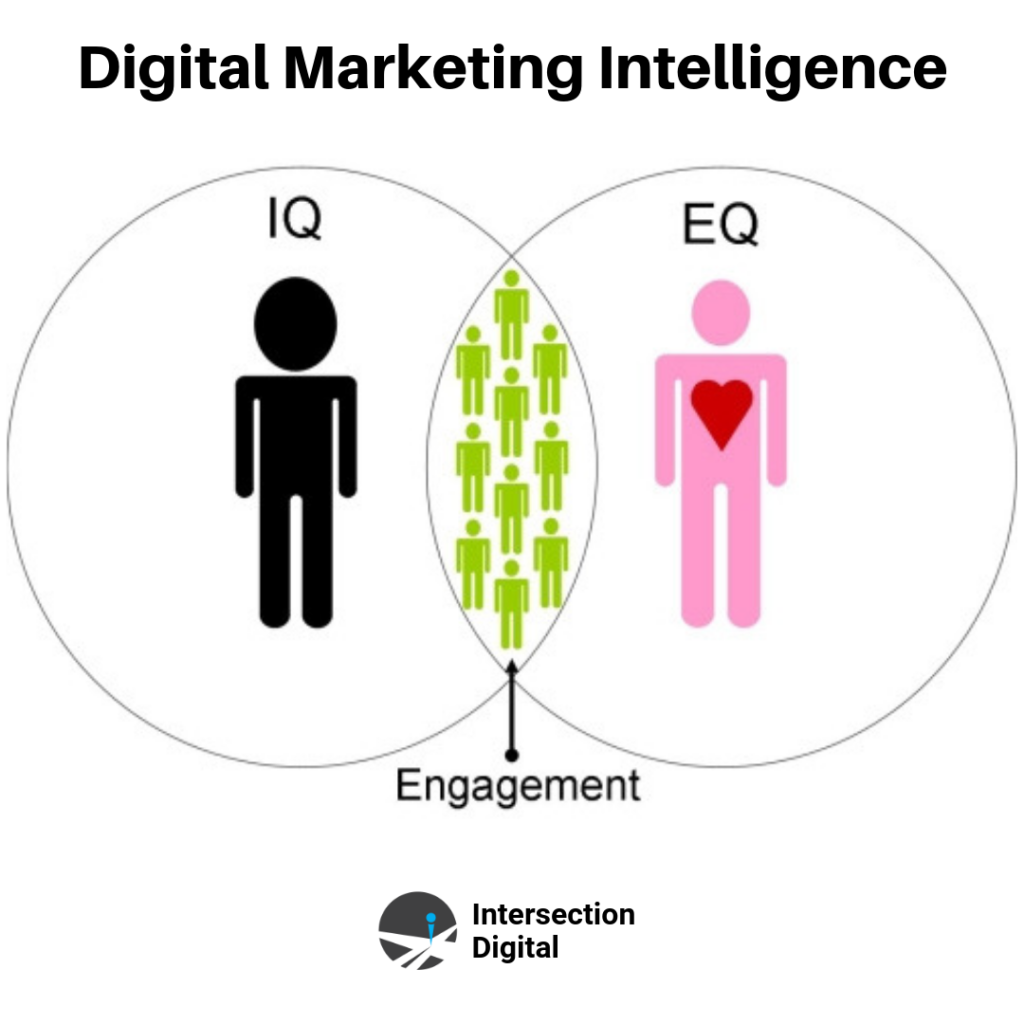
the balance between marketing iq and eq

Is marketing EQ becoming more important than IQ? If building a successful brand or simply selling your “stuff” depends on creating an emotional connection with your target audience, is your level of emotional intelligence as a marketer becoming as important as your ability to implement marketing tactics?

As social media and online marketing continue to provide infinite access to the marketplace, will your success be based more on learning how to use the tools or understanding the emotional needs of the people you are communicating with?

Changing Skill Set

Social media and search technology has changed the way businesses communicate with their tribes. New marketing skills will likely need to emerge and evolve in order to keep pace and increase the odds of success.

Louise Robertson, owner of Bright Business Concepts, a marketing communication agency in Guildford, UK, feels that the required skill set for marketers is changing rapidly.

“Building a successful brand depends on the ability to create an emotional connection with a target audience and the ability to message these groups in an engaging manner,” says Robertson. “Success is not only based on learning to use the tools but understanding the emotional needs defined by target audiences.”

Okke Amerongen, Owner of Okke Internet, a web consultancy in Utrecht, Netherlands believes the importance of emotional intelligence is highly underrated by marketers. He theorizes that the dynamics of traditional marketing create a Jeckell and Hyde complex amongst some marketers.

“Most marketeers actually have a high EQ when you meet them outside of work,” says Amerongen. “Once they take on their professional role as company marketers, most of them will think of ways to talk TO people and not WITH people.”

On the other end of the spectrum, Erica Friedman, President of Yuricon LLC, a publisher based in New York City, validates emotional connectivity but leans towards marketing IQ as being more important.

“Unless the emotional connection to a brand can be converted into action for a brand, emotion is pretty meaningless,” says Friedman. “I can say I ‘like’ or ‘love’ a brand, but unless there is some action attached to it, my support is empty – If marketers want to understand emotional equity, they need to understand how to harness that emotional energy…Just becoming a fan of a brand isn’t enough.”

Balance

Deborah Bifulco, Certified Guerrilla Marketing Coach and Owner of Bifulco Business Solutions LLC, an entrepreneur focused coaching and mentoring practice in New York City, thinks that your marketing EQ and IQ can’t really be separated. She suggests that, in order to be an effective marketer, businesses need to understand what drives people to buying decisions – and that implies some level of EQ.

“Granted, there are plenty of ‘functional’ marketers who are stuck on the facts, figures, mechanics, and metrics of marketing,” says Bifulco. “But, when you look at truly successful campaigns, more often than not, you will find that they have engaged us emotionally on some level.”

The New Frontier

Creating an emotional bond with the consumer is a fundamental in advertising – but has social media, and the possibility of engaging in real time micro-interactions, changed the relationship between marketing IQ and EQ? If so, how?

Martin Smith, Chief Technology Officer at TruEffect, a relationship advertising firm based in Denver, Colorado, feels that advertisers already understand the importance of an emotional connection at the mass market level – but that the need to balance EQ and IQ is becoming more visible when delving into the micro-marketing.

“Brand building in traditional media was/is all about EQ creating the emotional connection of the product to the consumers that, on a mass basis, moved the most share in aggregate,” says Smith. “In focus groups consumers relayed the emotion of how their soap powder was like a ‘white knight’ or other powerful sentiment of their association to the personality of the product.”

However, when it comes to social media, the playing field has totally changed. The single mass market has turned into multiple micro-groups, each with different needs. This highlights the importance of both tactical knowledge and emotional intelligence.

“In a market where we measure share, intent, action and need at a single user level, we are now able to see the balance more clearly,” says Smith. “But more importantly, we can take action on smaller groups – This creates new tension in the yin and yang of EQ/IQ. Instead of single position we can now move to micro-groups of multiple millions.”

In closing, Smith goes on to say that marketing in the social media era is not so much about increasing EQ over IQ or vise verse, but rather, understanding the difference and importance of both with the aim creating an effective combination.

“Now it is about aligning the optimal message (to micro-segmented audiences) to key drivers of engagement that combine EQ & IQ,” says Smith. “The traditional drivers of response, audience, timing, offer, creative, etc. are now within the web context – So when you work both sides of it, that is when you truly see results that deliver on the promise. We now have a different challenge of making ourselves relevant and emotionally connected with audiences of one in real time . . .but then that is why we built what we’ve built.”

BACK TO MAIN BLOG

Crap + SEO = Optimized Crap

March 30th, 2009

——————————————————————————————————————————–

“Performing search engine optimization on a crap-filled site just makes it slightly less crappy.” (David Meerman Scott)

Source: SEO and Your Crap Filled Site (Web Ink Now)

BACK TO MAIN BLOG

The Search Engine Marketing Gap

January 24th, 2009

———————————————————————————————————————————

By Mark Smiciklas

As consumers continue to use search engines as the primary tool for researching products/services and for finding solutions to their problems, are small business owners keeping pace with a commitment to search engine marketing (SEM)?

Research posted on Search Engine Land suggests a search gap between consumers and small business advertisers. If this holds true, what are some of the reasons causing reluctance to SEM?

Lack of SEM Appeal

Tim Cascio, owner of Chicago based GS Marketing Group Inc., sees most of his clients benefiting from search marketing – but some still feel that SEM doesn’t apply to their business. Tim feels there are four classifications that help define why search engine marketing may not appeal to some small businesses:

1. Status Quo

  • Members of this group have built successful businesses spanning generations.
  • They are often risk averse and have a high degree of confidence in last year’s print media schedule, regardless of how the media landscape has changed around them.
  • And, because of their profitability and past success, they don’t get excited about being responsible for a new initiative that they have to manage.

2. Lack of Expertise

  • Members of this group’s first and last attempt at search marketing was years ago and they love to describe how search marketing simply doesn’t work for their business.
  • This group is not likely to be familiar with the ever-increasing capability and sophistication of Google AdWords, including  Geography targeting, conversion tracking, ad scheduling, A/B pages and ad rotation. They likely ran 100 search terms or less with only one ad, pointing to their home page.

3. Half Way There

  • Members of this group underestimate the benefits of professional copywriting, compelling design and strong calls-to-action on their website.
  • Without these components, even the best search marketing implementation will fall short.

4. Conversions Too Costly

  • Members of this group feel that the paid search cost per sale is too high.

Regarding cost, Cascio goes on to say that “online consumer product stores should consider it a success to break-even on the first sale to new customers. When effective in-touch programs reach out to new customers and good products are offered at a fair price, it seems reasonable that many will become repeat customers, some for life. A low percentage of repeat customers would use paid search to order again so long as branding is reinforced throughout all packaging and communications. The original PPC investment pays off as soon-to-be loyal customers return year after year.”

Education

In many cases, it seems that ignorance prevents small business owners from adopting SEM and other online marketing strategies. Kelly Seiler, an engineer with Northrop Grumman in San Diego, has a personal story that helps illustrate this point.

Kelly’s father owns a transmission shop and always felt that a website and online marketing was not necessary – and not really worth his time and effort. “It took him attending a session at a conference to see the advantages of having an online presence,” says Seiler. “As a result of amazing returns in terms advertising dollar to sales generated he has scaled his yellow pages ad down to just a one-line listing and moved that money to search engine marketing.”

Corinne Montgomery, an internet marketing specialist at NetBiz in Portland, OR, agrees that lack of knowledge is holding some small businesses back from the benefits of SEM. She feels that many owners don’t really understand online marketing fundamentals and how the internet could be of value to their business.

Trust

Another component of education that may prevent small business owners from delving into SEM is trust – How many online marketing practioners lack the proper experience or qualifications, offer poor value or distribute bad advice?

Flyn Penoyer, a San Fransisco based website marketing expert, feels trust can be a major issue. “I think the main reason (small business) is reluctant to embrace SEM is that owners have seen too many people get ripped off by folks that claim expertise and fail to deliver,” says Penoyer. “It is obvious that many of these individuals are not working in the best interest of their clients.”

Alignment

David Gray, principal and strategist at DIG360, a retail consulting firm based in Vancouver, offers a different perspective. Gray feels that not all businesses may gain their initial or primary exposure as result of SEM. In these cases, online marketing tends to round out (rather than dominate) a consumer’s experience with a brand.

“I don’t question the premise that many consumers use search and that many small businesses don’t optimize websites for search,” say Gray. “But the two facts may not align as nicely as we would like.”

He goes on to say that consumers do not necessarily use search to facilitate every single interaction with a small business. For example, many people still prefer to go to brick and mortar establishments i.e. the mall, downtown retail stores, etc. to engage in the shopping experience first hand.

He adds another example: “Neighborhood dining is often triggered by passing by a restaurant – the physical media and the website are simply there to confirm a cross-street, menu or hours of operation.”

When it comes to business-to-business transactions, Gray feels that “the first exposure may through a more trusted route than search i.e referral, and a website visit acts to provide further information and credential checks.”

“I think each case needs to be vetted on its own merits… what are the high impact cases for SEM/SEO and where can other approaches yield as good or better result,” concludes Gray.

What to do think? Is there a SEM gap?

BACK TO MAIN BLOG

The New Target Market

January 16th, 2009

——————————————————————————————————————————–

By Mark Smiciklas

New Marketing should prompt small business to re-think the way they reach their target markets.

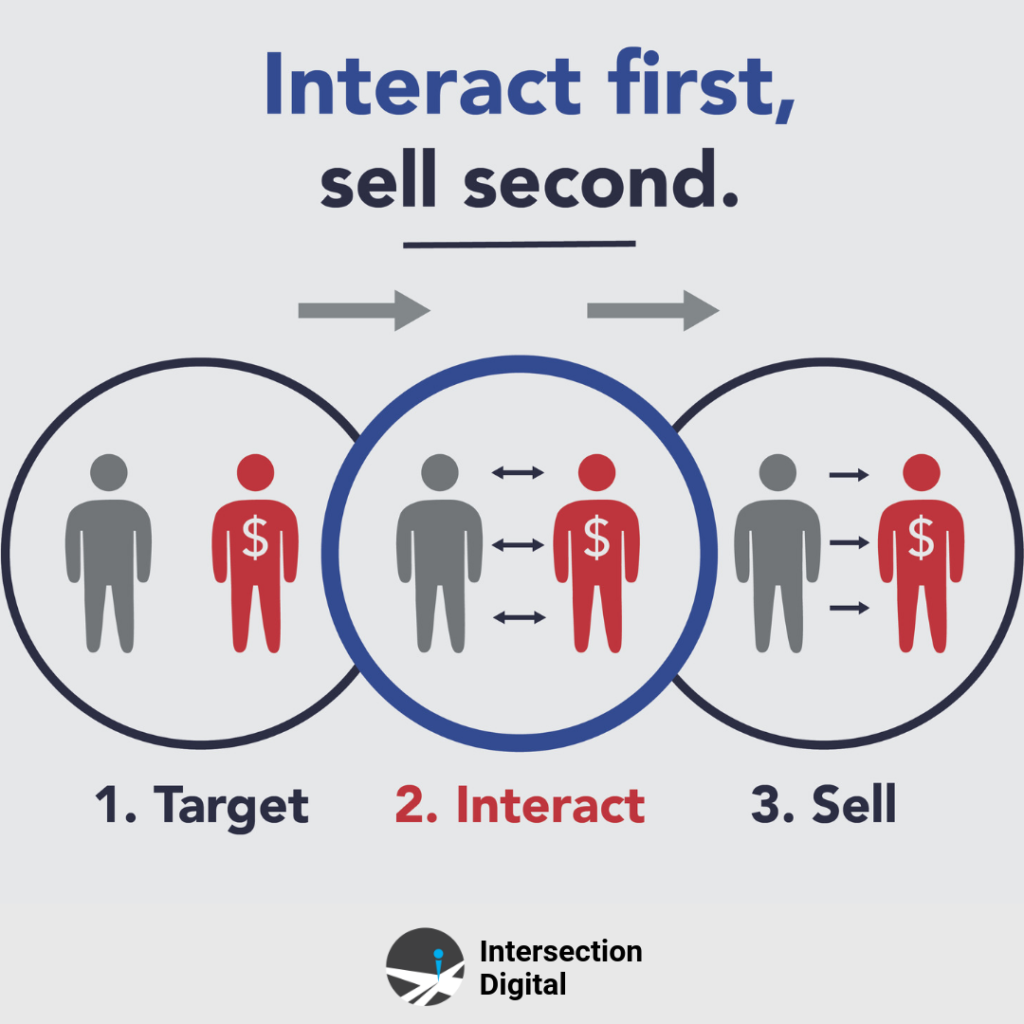
Old marketing is based on mass targeting – spend ad dollars and use mass media to push your message out to as many people as possible.

The idea: If you spend enough, spread your marketing messages far and wide and target the masses, people will eventually buy your product or service.

Old marketing asks questions like:

  • “Can you really afford not to target as many people as possible?”
  • “How much business are you passing up by not maximizing you advertising reach?”

New marketing is based on niche targeting – create content and use search engines/social media to engage interested people in your product or service.

New marketing poses questions like:

  • “How many passionate customers do you need to run a profitable business?”
  • “Are 100 truly interested prospects more valuable than 10,000 people who don’t really care?”

New marketing can be scary because it may not work the way you expect it to. It’s also harder than than old marketing because it forces you to:

  • Focus – “Who are my customers?”
  • Come up with content that adds value to your relationships and helps solve your target audiences problems

What do you think works better….Mass or Niche? Why?

BACK TO THE MAIN BLOG

Image Note: The document portion used in the image above is attributed to Tim Morgan

Touch Point – Website

February 5th, 2008

There is no shortage of factors to consider when it comes to the development and ongoing management of your small business website. For the purpose of this post, I want to share my thoughts on two topics:

  1. Calls to Action
  2. Design vs. Function

Calls to Action

A “call to action” is any activity on your website that requests your customer’s and/or prospect’s participation or commitment. This could be registering for a newsletter, filling out a form, making a purchase, sending an email, etc.

Calls to action are really important because they provide the opportunity for your website visitors to begin engaging with your brand – this is the first stage of the relationship building process between your small business and potential clients. Some call to action principles:

Icons - make sure that any call to action buttons, links, etc. stand out on the page.

Exposure – do your best to make as many of your calls to action accessible on multiple pages. For example, have a newsletter sign up button visible on all of your sub pages, not just the home page.

Value – it’s critical to provide something of value to your website visitors. Why would a potential customer give you a permission asset i.e. name, email address, phone number without receiving something of value in return? A good example is newsletters – I have seen so many websites that just have a newsletter signup box…”sign up for our newsletter”. No mention of the content and why it might be of value to the person signing up – make sure to clearly state what the newsletter is about and the benefits to signing up.

Form Length – when you are offering a demo, no obligation quote, whitepaper, e-book, etc., try to limit the number of information fields that are required to be filled in by the consumer. You don’t need to strike gold on your first attempt at mining data. Any form with more that 5 or 6 fields will have a low conversion rate. Whenever possible, start slow and ask for limited information – email address only works best. As long as you continue to offer value in future (permission based) communication, you will continue to have the opportunity to build a relationship with prospects and obtain more information over time.

Design vs. Function

Disclaimer: I am a big “design guy” – I appreciate great design, whether it’s graphic or structural, and understand the benefits of aesthetics. Okay, now that I have explained myself to all of the designers I know (and work with), I really need to rant a bit about website design.

In many cases websites designed purely on aesthetics are not very effective. Those flash sites look awesome, but aren’t as easy to navigate or as SEO (search engine optimization) friendly as “static” sites. I sat in on a Marketing Sherpa webinar last week – they made some interesting observations regarding online design practices when it comes to type fonts. Here’s a couple of excerpts:

“The average person over 40 won’t have an easy time (reading Verdana 10pt fonts) in the real world. Yet it’s still one of the most popular font/size combinations online”

“Oh and by the way, if your type is colored anything but black (and blue for hotlinks) people will have a harder time reading it.”

Just like anything – your website should be all about balance…a good mix of common sense, strategy and design.


Intersection Consulting is run by
Vancouver Marketing Consultant
Mark Smiciklas, MBA

604-809-0296
© Copyright 2008 - 2010 Intersection Consulting and Learning Ltd. All rights reserved.
Site by Vancouver Web Designer J. Klassen.